




A fascinating journey from Amman to Aqaba along Jordan's thousand-year-old King's Highway, admiring the spectacular scenery On this unforgettable trip, I stop along the way at the stunning Dead Sea, the immense Wadi Mujib canyon, and the magical city of Petra. Perfectly preserved Greco-Roman archaeological sites, medieval castles, mesmerizing landscapes, delicious cuisine, and vibrant cities are only some of the things I experienced during this wonderful exploration of a fascinating country.
Contents
Jordan is located in the Middle East and is bordered by Syria, Iraq, Saudi Arabia, and Israel. It is home to some of the world‘s oldest and most important cultural sites, including the ruins of Petra, the Dead Sea, and the ancient city of Jerash.
It is a popular destination for tourists from around the world. Visitors come to experience the country‘s unique culture, explore its ancient sites, and experience its stunning natural beauty.
Arguably the best way to visit the country is to rent a car and embark on a road trip across its incredible, beautiful landscape, making all the “mandatory” stops as well as letting serendipity take hold and enjoy incredible hidden gems off the beaten path.
Whether it is to enjoy the beautiful sea in the ancient city of Aqaba, the desertic, breath-taking landscapes of the Wadi Rum desert, the archaeological wonder left behind by the Nabatheans in the rose city of Petra, the wellness treatments on the Dead Sea, or the bustling nightlife in its capital, Amman, Jordan offers something for everyone.

What to expect
- All the possible tonalities of sand and beige colors imaginable.
- One of the safest countries in the world.
- Deserts. 75% of the country is desert.
- Hot and dry days and crispy, chilly nights
- Immense spaces and landscapes.
- Friendly people.
- It is quite expensive given the strength of the currency and the probable tourist destinations that will be visited.
Tips & Impressions
- Scenery: From the moment I stepped out of the airport in Amman, right until I stepped in at Aqaba, I was amazed by the tones of sandy colors. I did not think so many pastel tonalities existed. From the houses of Amman to the sedimentary layers of rock to the desert dunes This country is painted with a single color but in its infinite varieties.
- Friendliness: Jordanians are very friendly. Amongst each other, they will go out of their way to display affection and greetings. Towards visitors, they will often smile, wave, try to help, or start a conversation.
- Dead Sea: I’m still wondering how I managed to get out of the water of the Dead Sea when floating like a cork and without any propulsion from immersion whatsoever.
Overview
This road trip is quite short, at only a little more than 500 km. Yet the number of things to see is extensive, and the drive accounts for more than half of the enjoyment. There are two major highways but the best road to take is the old Kings Highway/Route 35. This road takes you to the mountains, winds within deserts, and is rarely used by locals who need to traverse regions in efficient manners. As such, it is beautiful to drive in and you will want to stop at every kilometer to take in the scenery.
See the Itinerary below for a detailed breakdown on every location.
Jordan at a Glance
- Language: Arabic is the official language in Jordan. English is widely spoken by learned people. There is also a significant percentage of people speaking French and German, as they are languages that can be taken as options in schools.
- Population: 10.4 million (est. 2019)
- Ethic Groups: 95% Arab, 5% other ethnic minorities (Druze, Assyrians, Circassians, Armenians)
- Religions: Jordan is primarily Muslim but there is a presence of Christianity. Compared to many other arab countries there is a high tolerance to other faiths
- Currency: Jordanian Dinar (JD).
- Credit Cards: Credit Cards are widely accepted in cities and ATM are are evenly distributed, although there is a high service fee charge
- Electricity: Socket types Europlug, British types, Schuko, 230 volt / 50 hertz
Check the Jordan page for more country general information

Getting around
Traffic Rules Basics
First and foremost, the basics: in Jordan, driving is on the right side and all common driving requirements are followed (i.e., mandatory seatbelts, it is illegal to drive under the influence, and the driving legal age is 18).
Speed limits range from 60 km/h in urban areas, 80 km/h on rural roads, and 120 km/h on highways. That being said, there are a lot of speed limit changes and a lot of police placed to check the respect of these speed changes.
Road signs are mostly both in English and Arabic. Sometimes they are only in Arabic but that is a good indication that you are going the wrong way and either entering a residential area or a place that is so devoid of any sightseeing or tourist attraction that it is best to return to the “normal” path.
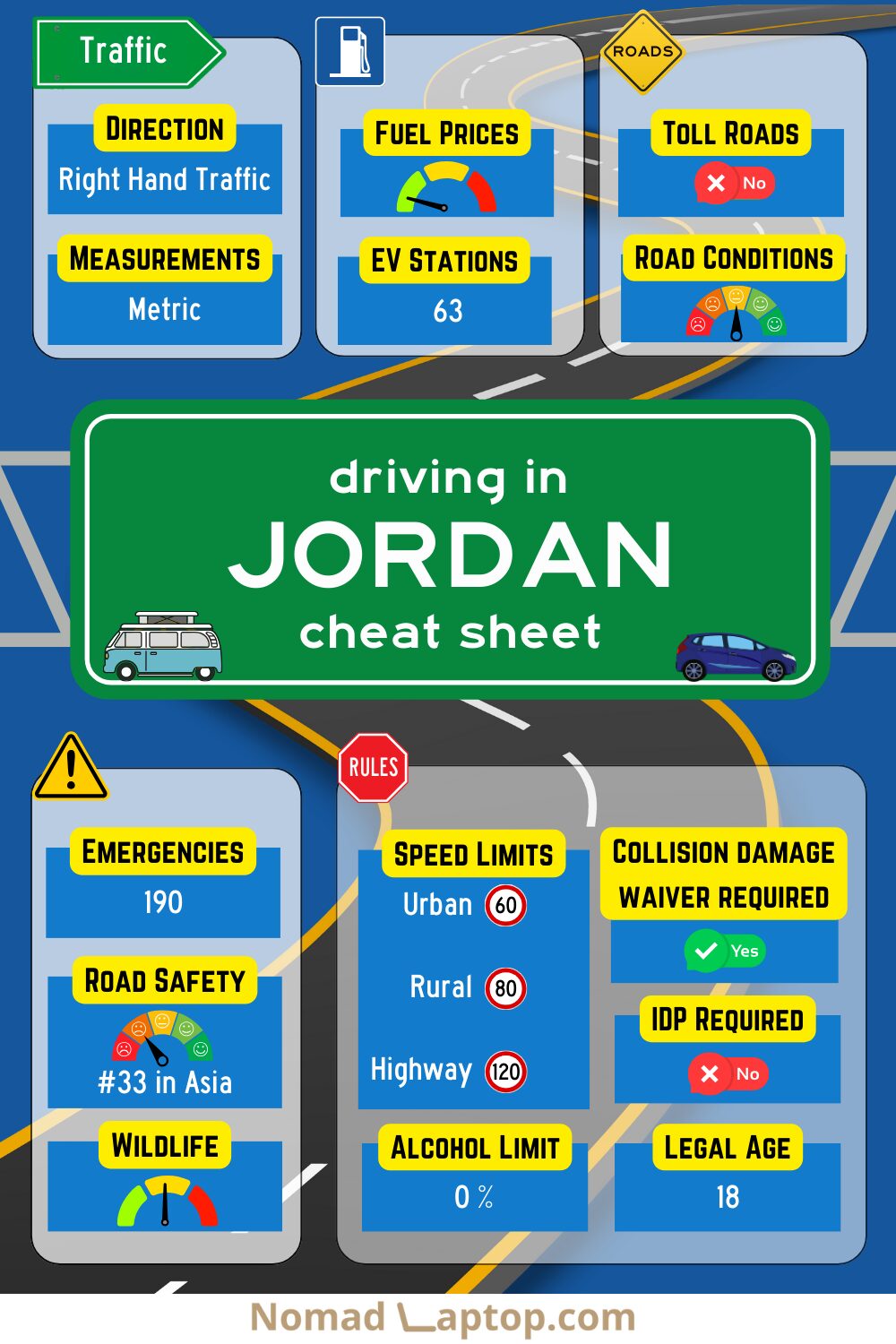
Save the driving cheat sheet for reference
Drivers license requirements
Contrary to many countries which use a different alphabet from latin characters, you can drive in Jordan with your local license without needing an IDP.
Also, it’s worth mentioning (considering the culture and laws in many Arabic countries) that women are allowed to drive.
Road Conditions

Jordan is a relatively small country and more than 75% of it comprises deserts. As such there aren’t many major roads. Specifically, there are 3 major highways:
- Highway 15, known as the Desert Highway, runs straight down the country, connecting the Syrian border and the southern city of Aqaba.
- Highway 35 is the historical Old King’s Highway
- Highway 65, the Dead Sea Highway, coasts the Dead Sea and connects Amman to Aqaba.
All these roads are in perfect condition, even the historical Old King’s highway (which by the way I highly recommend if you are planning to visit Jordan by car. The winding road will bring you within the canyons of the Jordan Valley and is simply breathtaking).
Other minor instead may have varying quality. There are the occasional potholes but nothing serious (unlike the ones that reach the center of the Earth as in Mexico). There are however several speedbumps, not only in urban areas but almost everywhere there is a crossing or some settlement. These also are nothing compared to the mountain-level Topes of Mexico which wreck your car if you do not see them on time.
If you decide to drive into the desert, you clearly need a good 4WD vehicle, as well as more than enough supplies, an offline GPS and anything else you might need (both things and knowledge) to avoid finding yourself stranded in the middle of a desert. For Wadi Rum, there is a fee that is charged to enter Wadi Rum Protected Area.
Driving
This all depends on the area. In the rural areas outside of cities, there are few cars and many police speed checks and speed bumps. People drive carefully and relatively slowly. There isn’t much sense of lanes or use of turn lights but the lack of traffic makes driving very easy.

A whole different thing is driving in cities. In the capital, Amman specifically, I was simply shocked. I have driven in about 15 different countries (mostly Europe, but also Australia, Canada, the US, Mexico, and Guatemala). But traffic in Amman is confusing, to say the least. It blends the chaos that one can find in Cairo or Bangkok but with larger roads, larger cars, and higher speeds. Turn lights and lanes are never used, but that is the least of the problems. The major issue is that everyone drives in their own bubble. Sort of like in Italy, when you find that one guy who just has to get ahead of everyone else and will overtake wherever he can, squeeze in impossible places and generally not respect any traffic lights or signs to give way. Except that here everyone, including pedestrians, behaves this way.
The general Jordan driving mantra seems to be “don’t ever stop”—you enter a highway or a main road from a side road and you just enter and then start squeezing through. You enter a roundabout and just enter, and then we’ll see. You are a street vendor and decide it is time to attract drivers by swinging your shiny metal plate, and you just walk into the right lane. This trickles down to everybody so all of these sudden “intrusions” are met with swerving to another lane. And this happens all the time and has this compounding effect. So a car entering the highway can have a real and sudden influence on you, even if you are three lanes away. This is most visible in roundabouts, where it is absolute mayhem.
Road tolls
At the time of writing, there are no tolls on the road but that is expected to change in the future. Jordan is undergoing the development of more road arteries and road infrastructure and it is expected that tolls will be added.
Fuel
Gas is done in the “non-American” way, for lack of a better word for it. This means payment is not done upfront to unlock the pump. Gas stations are usually serviced.
Gas prices are high compared to other countries in the Middle East.
All petrol stations that I encountered accepted card, but as always, having cash to be able to deal with more remote and rural areas, is always recommended.
Police

This is the most striking aspect as Jordan is definitely a policed country. From a safety point of view, it is one of the safest countries in the world and considered the safest in the Middle East. However this extensive control is reflected also in the driving controls and there are a lot of police blocks, strategically placed after major changes in speed limits or in vast descending parts of the road, ready to catch any driver who breaks the limits.
There are no issues of police corruption. The country is located in a fragile geopolitical location so there are these frequent checkpoints but once they recognize that you are a visitor, either by simply looking at the rental car or asking a question, they let you pass without further inquiries.
Driving Quirks
As stated above, driving is somewhat out of control in cities. As such driving etiquette mostly revolves around swerving around obstacles and not making a big fuss about anything. People will traverse the streets when they want/can and the same goes for cars. Do not expect to be thanked if you let someone pass and in the same way reprimanded if you cut someone off. The important thing appears to be to get things done and move on.
Apart from the aforementioned careless drivers in Amman, pedestrians are also quite “dangerous”. It is not uncommon to see people walking on the side of highways and they behave as if they were traversing a normal city road, walking carefree between the multilane highspeed road.
Flora and Fauna
With over 75% of the country being desert, most of the flora is composed of shrub trees, which can withstand the arid climate. Olive and cedar trees, as well as palm trees, are also common.

The desertic areas do not allow for much fauna except small mammals and lizards. As such you will rarely encounter road kill of wildlife. The country has a high percentage of dogs and cats and the foremost can easily be found on the side of the roads. As everywhere cats are either more diffident or agile than dogs so you will not see cats run over but there will be dogs. When it comes to animal crossings, there are herds of goats and sheep and there could be some road kill there. Other animals that are used as transportation such as horses, donkeys, and dromedaries all have owners so you may encounter them but their riders are clearly careful to not jump in the middle of the road.
General info & tips
Weather and Seasons
The climate in Jordan varies greatly because of its desertic landscape. The further inland and away from the Mediterranean, the greater the contrast in temperature. Above the Jordan Valley, the weather is dominated by a Mediterranean climate, whereas the northeastern areas are arid and desertic, therefore hot and dry with cool nights.
In summer, the temperatures average around 32 °C, sometimes reaching and exceeding 40 °C. In winter the average temperatures stand around 13 °C with occasional snowfalls in the mountainous areas.
Th best time to visit is during spring or autumn, which provide a pleasant weather with minimal rainfall. Springtime is especially beautiful as the desert blooms with wildflowers. If instead you prefer to avoid the crowds, the summer months are the best choice although can be quite hot, especially in desert areas. Winter should be avoided as it can get quite chilly and windy.
Generally speaking, you will experience two major climates: hot and dry weather during the day and chilly nights (for example, in the desert or from the winds in Amman).
Safety
- Safety: Jordan is a very safe country, considered the safest country in the whole Middle East. When it comes to solo travelers, both males and females can explore the country without issues. There is a strong presence of police and general security. Many hotels, tourist places, and public buildings have metal detectors.
- Natural risks: The region is prone to earthquakes. The most frequent natural risks revolve around droughts and extreme temperatures and the consequent risk of landslides and flash floods during storms.
- Emergencies number: 911
Safety Indices
Learn more on the data source and the methodologies of ranking in the Global Safety Indices page.
Itinerary
Amman
عَمَّان

About
Amman is the capital of Jordan and its economic, cultural, and political center. It is one of the largest cities in the Middle East and has been inhabited since the Bronze Age.
Amman is home to many ancient sites and monuments, including the Citadel, the Roman Theatre, and the Temple of Hercules. It is a vibrant city with a rich history and culture. Amman is known for its diverse population, with people from all over the world living in harmony. The city is also known for its excellent cuisine, shopping, and nightlife.
For more info on Amman check out this article

Jerash
جرش – Ǧaraš
About
Jerash nowadays is a small city of around 50 thousand inhabitants, 50km north of Amman. It was settled as far back as the Neolithic period and flourished during Greek, Roman, and Byzantine times. The city was abandoned after a massive earthquake destroyed large parts of it in the eighth century CE and after it was further destroyed during the Crusades.
Nowadays, the city is one of the most important tourist attractions in Jordan and is nicknamed the Pompeii of the Middle East because of the high preservation of its Greco-Roman ruins.
Drive
50kms north of Amman on historical Kings Highway, Route 35

Impressions
Jerash surprised immediately with its quiet atmosphere within the Greek-Roman ruins, despite them being immersed and surrounded by the new city of Jerash.
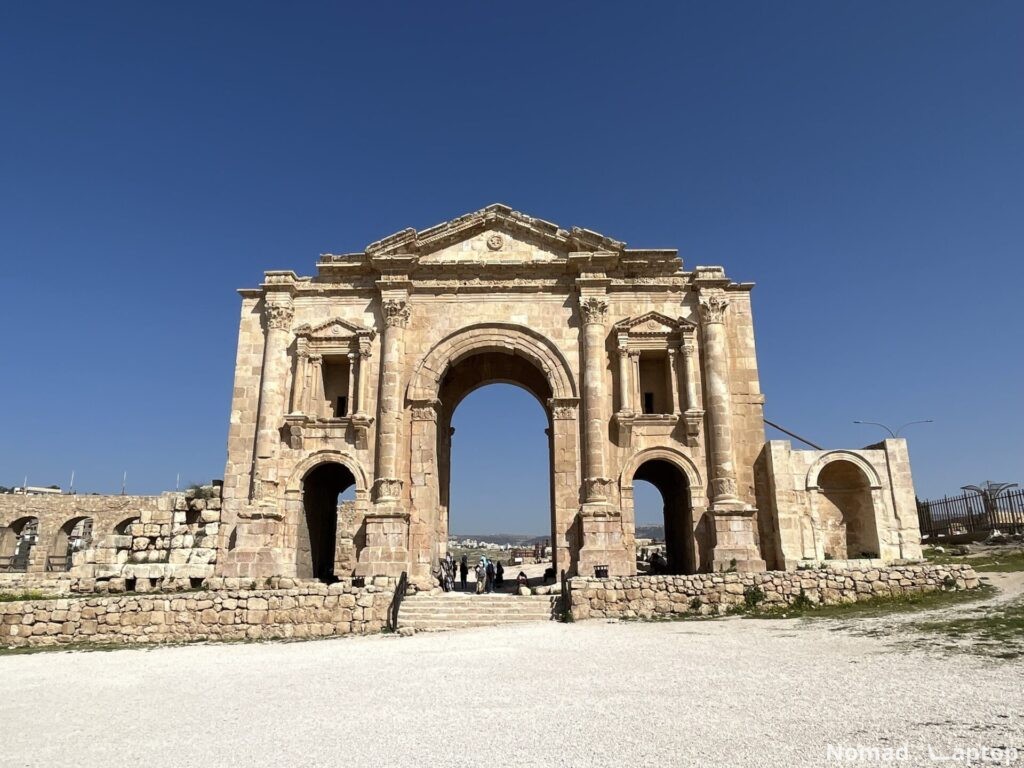
Immediately after entering the site, I was in front of the Arch of Hadrian, perfectly preserved and towering over the site. The more I ventured into the archaeological site, the more I would be confronted with perfectly preserved Ionic and Corinthian columns and temple ruins that appeared to have survived the passage of time, unlike many others I had seen before.
Jerash is perfectly preserved and a large site and walking within the ruins really transports you to a different age.
Dead Sea
اَلْبَحْرُ الْمَيْتُ – Āl-Baḥrū l-Maytū

About
The Dead Sea is one of the saltiest bodies of water in the world. It is 300 m deep and has a salinity of around 34%. That is 10 times as much as oceans.
It is also the lowest point of Earth, standing at 423 mt below sea level.
Because of its high salinity, no organisms inhabit it. It is devoid of fish or seaweed and only some small microorganisms can live in its waters.
Its salinity is beneficial to the skin and makes it the largest natural spa. It has been frequented by people because of its properties since biblical times.
Drive
50kms from Amman on the Dead Sea Highway, Route 65.

Impressions
I did not cover myself in mud or sunbathe on the shores (the Dead Sea has the lowest risk of sunburn due to its altitude and water evaporation). But I did test the buoyancy of the water.
Super weird.
I naturally float quite well and as soon as I walked into the sea, I did my usual couple of steps to reach knee depth and then plunged in. Or rather, attempt to plunge in, as I basically glided on the surface like a cork.
It’s funny how your body will try to learn and understand something when put in an unexpected situation.
As I floated with my legs, arms, and torso above the water with only half of my pelvis under water, I realized how hard it was to navigate. There is no swimming, of course, but paddling also becomes difficult.
I also lightly bathed my lips in the water and almost vomited from the salinity, which, as said above, is around 10 times as much as the ocean and something like 15 times as much as salted water used for cooking usually is.
So yeah, the best metaphor is a cork dropped in the water and which constantly turns on itself.
Wadi Mujib
وادي الموجب, Wadi el-Mujib

About
Approximately 90 kilometers south of Amman, in the Jordan valley and to the east of the Dead Sea, is the Mujib reserve of Wadi Mujib. The immense canyon was formed during the last age, forming layers upon layers of sediment.
The area is sparsely vegetated, with steppe-type vegetation on plateaus. Today, a large lake has formed due to the Mujib Dam, which was constructed.
Drive
80 km south of Amman, coasting the Dead Sea, on the Dead Sea Highway, route 65.

Impressions
The dramatic rock formations and canyon that open up after the Wadi Mujib Dam are impressive, to say the least.
From the Dead Sea coast, the road is amazing and twists within the giant desertic rock formations. Upon reaching the top, the path continues onto the proper Kings Highway, which slowly leads to the canyon gorge and passes next to the dam.
Every single spot is impressive in its scale and panorama. The valley is also explorable on foot and is popular for hiking.
After descending into the canyon, I proceeded a little longer to the first larger town, the city of Al Karak.
Al-Karak
الكرك

About
Al Karak is also an important town historically speaking, as it has been inhabited since the Iron Age. It was targeted during the Crusades, was part of the Ottoman Empire, played a role during the Arab revolt, and was later occupied by the British.
Today, it is a relatively small city with just over 50 thousand inhabitants and is mostly known for its imposing medieval castle overlooking the valley beneath it.
Drive
Al-Karak is inland, 30 kilometers east of Gawr al-Mazraah, the last settlement coasting the Dead Sea.
Impressions
Karak is nothing special. It is actually pretty barren and even finding a decent hotel or restaurant is difficult (which I didn’t).
The Kerak castle, though, is impressive. I enjoyed the lack of signs, barriers, or a predetermined pathway to visiting the castle grounds. This created all these situations where I would find small alcoves or openings that would lead to entire underground levels.
Wadi Musa – Petra
ٱلْبَتْراء – وادي موسى

About
Petra is the top tourism destination in the country and rightfully so. The ancient city built by the Nabatheans is unique, part of the New Seven wonders of the World, and a Unesco World Heritage Site since 1985. It is also known as the “Lost City” since it was only rediscovered in 1812, despite being built in the 3rd century BCE.
It’s unique atmosphere and architecture, with its monuments carved in the layered pink rock canyons, make it a sight to behold.
Drive
145kms from Karak on the historical King’s Highway, Route 35
For more info on Petra check out this article

Aqaba
الْعَقَبَة

About
Aqaba is the only city in Jordan that faces the coast and has been an important port for thousands of years due to its strategic location on the northeastern tip of the Red Sea between the continents of Asia and Africa.
Today, it is an important tourist destination for its beaches, diving, and water activities. Because of its close proximity to the Wadi Rum desert and Petra, it is also a tourism hub for these destinations, making it one of the most important cities in the country.
It played an important role during the Arab revolt, which was iconically depicted in the famous movie Lawrence of Arabia.
Drive
100 km from Petra/Wadi Musa on the Kings Highway, Route 35.
Impressions
Also here, I only spent a day in Aqaba and cannot say much. The weather was wonderful, with long promenades on the coast. I took a cheap hotel in the city center but the only evening I had was in one of the many resorts in the hotel area, which was clearly wonderful. From the little that I saw, I can say that spending a relaxing week in one of the mega resorts must be wonderful, as the weather, beach, Arabic atmosphere, and awe-inspiring sunsets are sure to make a memorable stay.
Another thing which I leave for another future trip.
Closing thoughts
My time spent in Jordan was wonderful in every aspect. The weather was perfect (although I did underestimate the cold on one night in the desert camp near Petra). The food was great and the landscapes that are seen while driving around are awe-inspiring.
I did travel on the tourist-beaten path so clearly I did not experience a lot of the genuine country, but what I saw was a wonderful mix of Arabian traditions and modern influences. Despite having a rich history and long-held traditions, it is seamless for western tourists to navigate and interact with people.
I definitely recommend visiting this beautiful country and I would suggest taking more time than I did. Enjoy more of the desert, visit some other historical cities such as Madaba, or visit the more temperate regions to the north. Or even better, include it in a larger tour of the region with a trip to nearby Israel.


